Tag: Mythology

  • The World of Folklore and Mythology

    The World of Folklore and Mythology

    January, 2020

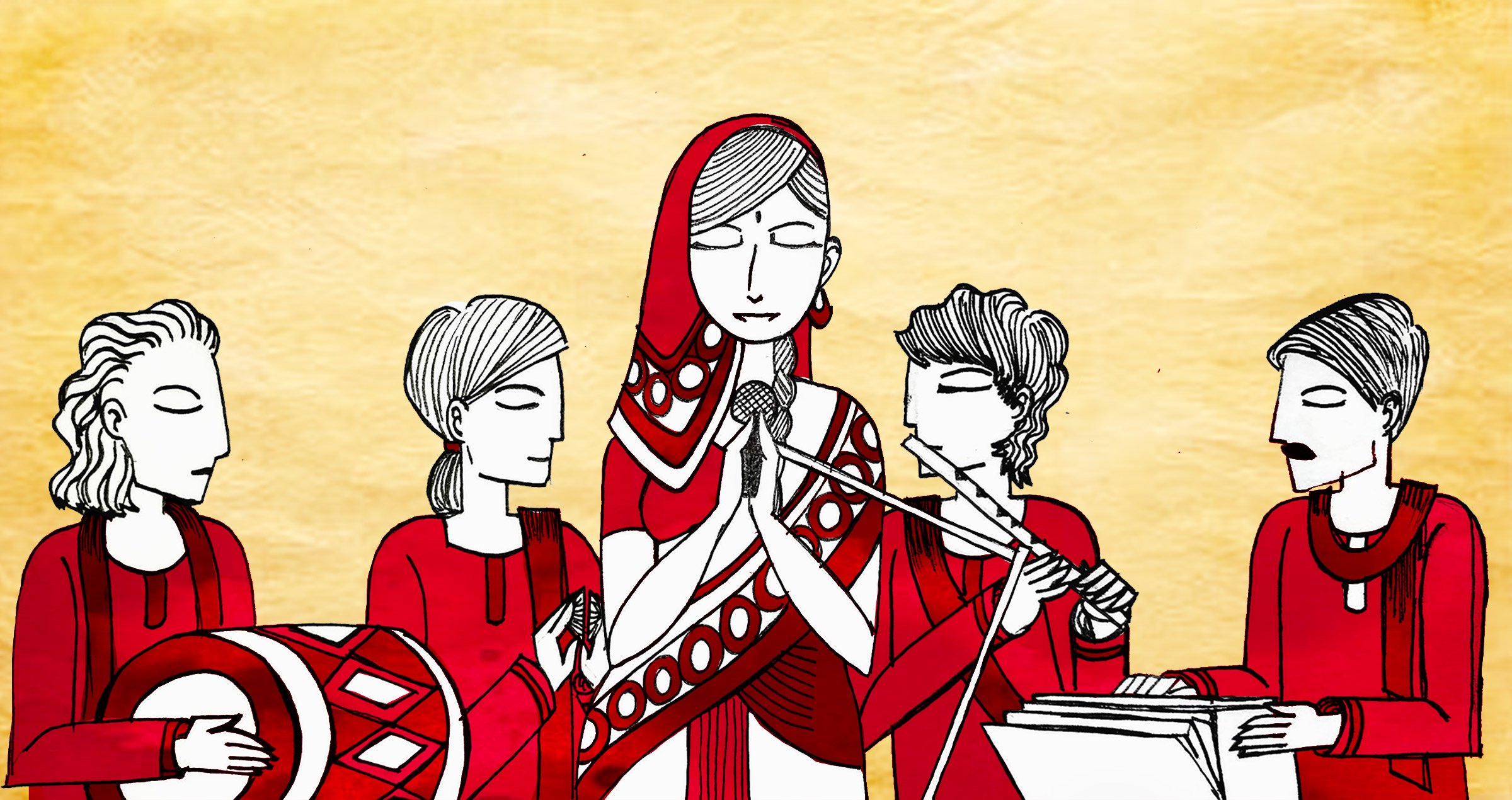
    In the age of Alternate Facts and Fake News, Fundamatics thought it would be interesting to devote an issue to Folklore and Mythology. This is not an attempt at being flippant but to an honest effort to bring together a collection of diverse stories from various parts of the country. Folklore is how a People imagine their past and themselves. Folk tales become icons of cultures, and in turn, cultures get manufactured around these tales. The tales are told in various art forms – storytelling, singing, theatre, paintings, sculpture and handicraft – and in turn these art forms shape the tales. We are constrained here to limit ourselves to the written word but the written word is no mean instrument – as we shall see* (hum dekhenge ).

    (more…)

  • Storytellers: The Tribe of the Hope Whisperers

    Storytellers: The Tribe of the Hope Whisperers

    When humankind attained wisdom and knew all that is good and bad. There was born the teller of tales; a small tribe of people (men and women), who watched and observed what no one saw. Creative, imaginative, highly skilled and having a perfect understanding of the human psyche, these people have the ability to touch the human heart with their words alone. To weave tales, by laying the selective warp and weft of time and space. Piece by piece, word by word, they build up perfect universes out of nothingness. Like a conjuring artist. They transpose the partakers in a time and place removed from the present. This ability gives them immense power, for unknown even to themselves they can mould and shape the thoughts of an entire generation. Call them influencers if you will. 

    (more…)
  • Ecological Consciousness and the Tale of the Nabagunjara from Folk Odisha

    Ecological Consciousness and the Tale of the Nabagunjara from Folk Odisha

    Illustration 1: Nabagunjara Patachitra painting by Shri Kalu Charan Barik. Photo credit: Abhimanyu Barik

    The Patachitra traditions of Odisha are replete with artistic, cultural, and symbolic connotations. The stories from the eighteen Mahapuranas, Upa-puranas, Mahābhārata, and other epics are the core of the Patachitra lineage in Odisha. These tales from the oral or the verbal classical and folk traditions when translated into the visual medium through art, become richer and highly emblematic. Imaginative terrains associated with these artistic mediums have storytelling as their central motif. There have been several discursive papers, books, and reflection articles that narrate the stories that are depicted in Patachitras, and of late there is a renewed interest in the Puranic stories especially those concerning animals and their interpretations in paintings and other new mediums. This article focuses on one such aspect of the Patachitra’s storytelling tradition which is a recurrent motif in several paintings made in this style from the ancient times to its contemporary expressions – the story of the Nabagunajara (in colloquial Odia) or the Navagunjara besa (form/attire). Over the past decade, there has been a massive interest in understanding the story of the Nabagunjara. Devdutt Pattanaik created popular interest in the word Nabagunjara with a brief mention of the tale in his book Indian Mythology: Tales, Symbols, and Rituals from the Heart of the Subcontinent (2003). There has been a persistent interest in the Internet world to narrate the symbolic as well as the artistic meanings concealed within the story of the Nabagunajara. Stray articles with limited research have been circulating on the Internet with half-baked reflections on the Nabagunjara. 

    (more…)
  • The Afterlives of Karbala in Bengal

    The Afterlives of Karbala in Bengal

    The battle of Karbala was fought in the desert of Karbala in central Iraq in 61 AH (680 AD). During the Karbala battle, the Shia leader and Prophet Muhammad’s grandson, Imam Husayn, along with his family and troops, was tortured and killed by the troops of the Sunni leader, the Umayyid caliph, Yazid. The tragic climax of a long-drawn war of inheritance between the prophetic line and the caliphate, the martyrdom of Imam Husayn and his family is commemorated during the first month of the Hijri calendar, Muharram. The Karbala ritual, as this kind of commemoration has come to be called, was first institutionalised by the Buyid dynasty in tenth-century Iran. From there, the ritual has spread far and wide throughout the Islamicate world, including in Bengal, which before the Partition of 1947 was a Shia-minority region.

    (more…)
  • In Conversation with Devdutt Pattanaik

    In Conversation with Devdutt Pattanaik

    Devdutt Pattanaik writes on relevance of mythology in modern times. Trained in medicine, he worked for 15 years in the healthcare and pharma industries before he plunged full time into his passion. Author of 50 books and 1000 columns, with several bestsellers, he is known for his TED talks, his TV shows especially Devlok, and his innovative views on culture, leadership and Indian approach to management. As any issue on mythology would be incomplete without any input from Devdutt Pattanaik , the Fundamatics editorial team reached out to him with few questions that we thought would be interesting for our readers. We are fortunate that he agreed to respond to queries. Hope that you, our readers, will find his replies and comments illuminating, as we did. The illustrations used in his article are by Devdutt Pattanaik.

    (more…)
  • Mythology’s Hand in History

    Mythology’s Hand in History

    Mythology in the Modern Age

    Guided by the hands of Reason and Science, one would imagine the modern age has little place for endless epics, speculative reflections and metaphysical meanderings. While Mythology may have occupied centre stage in times of yore, one may well ask what place it has in today’s world. The answer is more complex than it appears. 

    One area where Mythology has wielded a heavy hand is during the Indian Freedom Movement. From influencing the methods and philosophy of leaders like Gandhi and Tilak, to providing a subject upon which artists built nationalist visions, Mythology became the guiding force of History. 

    (more…)
  • Hayagriva – The Bestower of Knowledge

    Hayagriva – The Bestower of Knowledge

    jñānānandamayaṁ devaṁ nirmalasphaṭikākr̥tim ।
    ādhāraṁ sarvavidyānāṁ hayagrīvam upāsmahe ॥

    This is a prayer that children, especially in a vaishnavaite home, are taught to recite before embarking on any learning activity. Knowledge is held on a high pedestal all across the globe. And the Indian tradition acknowledges this great value of knowledge by paying respects to the divinity associated with this facet of life by offering verses of praise and worshipping through rituals and festivals.

    (more…)