Author: Chandru Chawla

  • Editorial: Living with Hope

    Editorial: Living with Hope

    [vc_row][vc_column][vc_column_text]

    Illustration by Nilapratim Sengupta

    [/vc_column_text][vc_column_text]The headlines on the front page of the New York Times on 1 Jan 2020 were normal:

    • Iraqi Protesters assault embassy after US strike;
    • E.P.A policies scorn science;
    • 3 passports and a plan hatched in Lebanon – Carlos Ghosn’s Escape Act;
    • As the markets soared higher, it was best not to look down;
    • Nowhere else to run (in Australia);
    • US set to ban vaping flavors teens most use.

    Some context, for those who may find the above from a distant era:

    • The Bush Doctrine – America must spread democracy – was facing checkered success in Iraq.
    • The US had already quit the Paris Climate Change agreement and the E.P.A was being shown its place.
    • A celebrated global corporate titan, the toast of the automobile world, was running away from charges of financial misconduct.
    • Global markets were happily seeing a prolonged bull run.
    • Forest fires, Down Under, had the world up in arms about the impending environment doom.
    • And vaping, a teen rage, was the new health threat!

    [/vc_column_text][/vc_column][/vc_row][vc_row][vc_column][vc_column_text]As I sit to write this, 370 days later, the world is watching in real time, the Temple of Democracy in Washington DC, being breached, while it awaits a “peaceful” transition to a new President. This is happening while the world is in the grip of a pandemic, which has taken almost 2 million lives already and infected nearly 90 million. Many ruling leaders have seen the pandemic as an opportunity to further consolidate their power, threatening liberty and fraternity nearly everywhere. India saw a merciless regime testing the resilience of millions of urban migrant workers walking several hundreds of kilometers back home, lakhs of farmers protesting bills that threaten their lands and livelihoods, and scantily equipped health workers at the frontlines of the pandemic, while millions of ordinary citizens and thousands of not-for-profits showed what humanity and compassion can achieve.[/vc_column_text][/vc_column][/vc_row][vc_row][vc_column][vc_column_text]No leader, observer, commentator or scientist of any standing saw this coming in the way it did. And yet, here we are, trying to reimagine a new world. For as Martin Luther King Jr said, “We must accept finite disappointment, but never lose infinite hope”[/vc_column_text][/vc_column][/vc_row][vc_row][vc_column][vc_column_text]This edition has an extraordinary array of writers speaking on wide-ranging topics like effective delivery of justice, financial inclusion of the marginalized, existential issues of a social sector startup, transition to e-learning, mental health during a pandemic.[/vc_column_text][/vc_column][/vc_row][vc_row][vc_column][vc_column_text]Shailesh Gandhi speaks of the need to adapt to a new normal and to seek opportunity in it. He sees an e-justice system as an effective means of dealing with colossal pendency and to improving access to justice. It is an opportunity to ponder on some important questions. Is technology the solution to universal, fair, consistent and speedy justice? Can it help in ensuring that “justice is not only delivered, but seen to be delivered”? Can accessing a justice system become as easy as making a WhatsApp call? For everybody, everywhere?[/vc_column_text][/vc_column][/vc_row][vc_row][vc_column][vc_column_text]Dr. Mrinal Patwardhan speaks to us about the new Teaching – Learning paradigm. Its need to find the right balance between “the presence of tech in teaching” and the “absence of human touch in learning”, and the challenges the academic world is facing in this journey.[/vc_column_text][/vc_column][/vc_row][vc_row][vc_column][vc_column_text]Alkesh Wadhwani and Prabir Borooah speak passionately about an extraordinary national milestone in providing millions of underprivileged citizens access to basic “banking services” and the role that technology is playing to bridge an inequity that has existed for decades. The authors appreciate the irony and the challenge of empty or inactive bank accounts just as many appreciate the irony of “bulging granaries but hungry people”[/vc_column_text][/vc_column][/vc_row][vc_row][vc_column][vc_column_text]Jishnu KR has a wry take on life in the campus during these dark, challenging times, while Shivani Manchanda offers a perspective on an issue still widely considered TABOO in Indian society – that of mental health. One can’t help but wonder – is there another crisis looming ahead? An invisible one?[/vc_column_text][/vc_column][/vc_row][vc_row][vc_column][vc_column_text]Anu Prasad shares her travails in keeping a “not-for-profit” startup afloat in this crisis and the lessons she is taking forward from the numerous real-life examples of humanity and compassion triumphing over desolation, despair and disillusionment that she witnessed during this period.[/vc_column_text][/vc_column][/vc_row][vc_row][vc_column][vc_column_text]Raj Nair takes a succinct look at some trends that may become the “new normal” in the short term.[/vc_column_text][/vc_column][/vc_row][vc_row][vc_column][vc_column_text]Runal Dahiwade and Miraj Vora give a glimpse of a startup whose offering, serendipitously, turned out to be apt for the post-Covid era. Their experience underlines the need for speed, agility and adaptability in uncertain times.[/vc_column_text][/vc_column][/vc_row][vc_row][vc_column][vc_column_text]As the world gets closer to the pandemic antidote, there is realization in the privileged class (that IITians represent) that we are pretty much locked into a new paradigm for some time – a surreal digital life in the safety of a gated cocoon,  an urban obsession over personal hygiene and health, a growing tolerance to fanaticism and divisiveness in society, a rapidly expanding social divide intermixed with numerous tales of individual courage and resilience. A crisis, especially an unprecedented one, provides impetus to tackle universal issues such as:[/vc_column_text][/vc_column][/vc_row][vc_row][vc_column][vc_column_text]

    • Finding lasting solutions to poverty, illiteracy, human trafficking and social inequity
    • Survival of conventional capitalism. Should we be looking at new economic models that encourage and incorporate human compassion, planet conservation, social equity and the need for physical and emotional wellbeing?
    • Need for ensuring universal access to affordable and quality health, education and food. Solutions that prevent citizens from getting locked into an infinite debt spiral.
    • Providing a shock-absorbing cushion to the most marginalized – children, women, the LGBTQ community, urban and rural workers, farmers, those discriminated on race and caste and many more.

    [/vc_column_text][/vc_column][/vc_row][vc_row][vc_column][vc_column_text]There will be another pandemic. There will be more climate change triggered natural disasters. And human compassion, innovation and enterprise may still prevail. But what cost will it exact the next time around – to our lives and to our souls? Sunder’s poem, Privilege, gives us hope.[/vc_column_text][/vc_column][/vc_row]

  • Climate Change Battle – The Youth are at the Forefront

    Climate Change Battle – The Youth are at the Forefront

    [vc_row][vc_column][vc_column_text]

    Illustration by Derek Monteiro

    [/vc_column_text][/vc_column][/vc_row][vc_row][vc_column][vc_column_text]The fight against the pandemic has entered its eighth month and India has seen floods in West Bengal, Assam, Orissa, UP, Bihar and Kerala. It has affected over 125 million people, leaving over 500 people dead and over half a million uprooted from their homes. Right in the middle of one of the severest lockdowns the world has seen so far.  It has resulted in multi-billion-dollar devastation. And even then, the mainstream media is paying lip service to the most visible manifestation of climate change, alongside the equally visible zoonotic pandemic. It has chosen, among many inane issues, to “conduct a media trial” around the tragic suicide of an actor and narcotic drug abuse in the film industry. The Union government has been very busy too. It has tested opposition governments in different states, offered questionable economic recovery packages, inaugurated a temple site violating physical distancing norms, taken legal action on poets, writers, teachers, lawyers and activists, issued a controversial and arguably reckless EIA draft, announced a move to allot coal mines in pristine forests and biodiversity hot zones, run amok with irrational projects in Mollem National Park in the Western Ghats. The speed at which the government has chosen to approve projects in wildlife sensitive habitats has caused serious concern among the informed but has not yet entered the national consciousness. [/vc_column_text][/vc_column][/vc_row][vc_row][vc_column][vc_column_text]Yet in the midst of all the chaos, the Ministry of Environment, Forests and Climate Change received 1.7 million responses on the draft of Environment Impact Assessment 2020! After the ill-fated attempt to thwart an online campaign group with UAPA charges, an attempt which was later aborted. The uproar around the projects in Mollem, Goa from writers, poets, scientists, conservationists, ecologists, teachers led by some very imaginative student activism triggered the Supreme Court-appointed Centrally Empowered Committee (CEC) to intervene and seek an explanation from the National Board of Wildlife on the clearances. The online and offline Save Mollem Campaign was so strong that it caused the Goa Chief Minister to suspect a foreign hand! And there was – the students and the youth created such a powerful campaign that it attracted solidarity and admiration from Europe, Africa and other parts of the world. Hardly surprising, given the allure of Goa as a tourist’s paradise! [/vc_column_text][/vc_column][/vc_row][vc_row][vc_column][vc_column_text]The active participation of students in the environment and climate change causes is a refreshing change. They see this as their fight, their own fight, sometimes, their solo fight – to secure their future. A fight where older generations, complacent in their affluent cocoons, are reluctant to upset the status quo. They see through the eyewash that the legislators fling on them in the guise of “sustainability and essential development”. The Work from Home scenario gives them more time on their hands. And that has also heightened their interest. Very appealing audio-visual memes are constantly pouring out. They are doing their job in multiplying the followers. The local/global networks that have been formed at There is No Earth B and Extinction Rebellion India are creating open repositories of information that can be used by any of the activist groups. Causes as diverse as Assam Floods, Vizag Mangroves, Save Aarey projects are covered here. Save Mollem Goa and My Mollem Goa groups, with active student participation, have brought together a diverse collective of scientists, artists, poets, illustrators and other creative people. [/vc_column_text][vc_column_text]

    The active participation of students in the environment and climate change causes is a refreshing change. They see this as their fight, their own fight, sometimes, their solo fight – to secure their future. A fight where older generations, complacent in their affluent cocoons, are reluctant to upset the status quo.

    [/vc_column_text][/vc_column][/vc_row][vc_row][vc_column][vc_column_text]All this has resulted in a breathtaking outpouring of creative content to save this pristine biodiversity hotspot in the Western Ghats. Fridays For Future India and Let India Breathe are playing similar roles. Let Me Breathe, powered almost entirely by youngsters, brings everyday sustainability and climate change stories from all over India. Using digital tools, it invites the youth to influence behavioural and policy level changes. Equally inspiring are emerging youth/teen voices  – such as Aarav Seth, who as a teen is rallying support for the UN Sustainable Development Goals (SDGs); Licypriya Kangujam, a 9-year-old from Manipur, who addressed the United Nations Climate Change Conference of 2019 and takes pride in offering creative solutions to turn everyday waste into everyday usable items; Femin Johny, a Kerala teen who champions the cause of planting trees, and many others like Aditya Dubey and Ridhima Pandey who have added their voices to these causes. [/vc_column_text][/vc_column][/vc_row][vc_row][vc_column][vc_column_text]The work initiated by Magsaysay awardee, P Sainath is no less noteworthy. His news portal, People’s Archive of Rural India, covers rural lives and livelihoods. They launched an initiative called PARI Education for schools. This initiative puts a human face on textbook concepts in everyday life in rural India. Driest topics like poverty, pollution, drought, farmer suicides and unsustainable livelihoods come alive through powerful storytelling by the people who face these daily. Kids for Tigers is another educational outreach programme from the Sanctuary Nature Foundation that touches the lives of rural kids living right next to the tiger and urban kids across the country. Going way beyond conservation education, the programme is dedicated to leaving kids with a better planet and leaving the planet with better kids.

    It is a shame that the Environment and Climate Change causes have not attracted popular contemporary icons from society. Jairam Ramesh, an IIT Bombay alum himself, is perhaps the only politician who has made Environment and Climate change the cornerstone of his politics. Other than Dia Mirza, who is UN Goodwill Ambassador for Environment, there is hardly anyone from Indian Cinema or Cricket that has joined this movement. Amitav Ghosh and Arundhati Roy are perhaps the only globally known Indian celebrities from the literary world who have not only identified themselves with these causes but have also written critically acclaimed stories around these subjects. The young need new role models. They should be encouraged to explore the works of Vandana Shiva (Food sovereignty), Sunita Narain (Rural eco-regeneration), Medha Patkar (Narmada Bachao and other people’s movements), Prerna Singh Bindra (Conservation related journalism), young conservation and ecology scientists like Neha Sinha, Vidya Athreya, Jis Sebastian, Nandini Velho, Krithi Karanth, Purnima Burman, Prachi Mehta, Veena Srinivasan, cartoonist Rohan Chakravarty (Green Humour), Anushka Ravishankar (children’s books), Abhijit Prabhudesai  (Rainbow Warriors), legal luminaries in environment law and justice such as Ritwik Dutta, Claude Alvares and Norma Alwares; Shweta Wagh (Urban ecology, heritage conservation) among many others. Narsanna and Padma Koppula, Bharat Mansatta, Madhu Reddy, Malvikaa Solanki and others are paving the way in the field of agro-ecology, championing Permaculture – a way of natural, sustainable farming and a way of life. Recent films like Kiss the Ground and Planet of the Humans have captivated the attention of the youth and given them different perspectives. The former focused on Soil Regeneration and the latter on the controversies surrounding Green Energy. [/vc_column_text][/vc_column][/vc_row][vc_row][vc_column][vc_column_text]The young need all our help and support. They don’t need adults trolling them, questioning their evolving knowledge or their motives. They don’t need experts shaming their biases or their passion. They do need gentle help in understanding the issues in-depth, the Science, the options with the latitude to dream freely. They do need monetary support to follow their passion. The privileged should not hesitate to dip into their pockets to support them. They should see this as an investment in Inter-Generational Equity and in character building. Bob Dylan once said, “Passion is a young man’s game.”[/vc_column_text][/vc_column][/vc_row][vc_row][vc_column][vc_column_text]

    A healthy planet need not be a moonshot.

    [/vc_column_text][/vc_column][/vc_row]

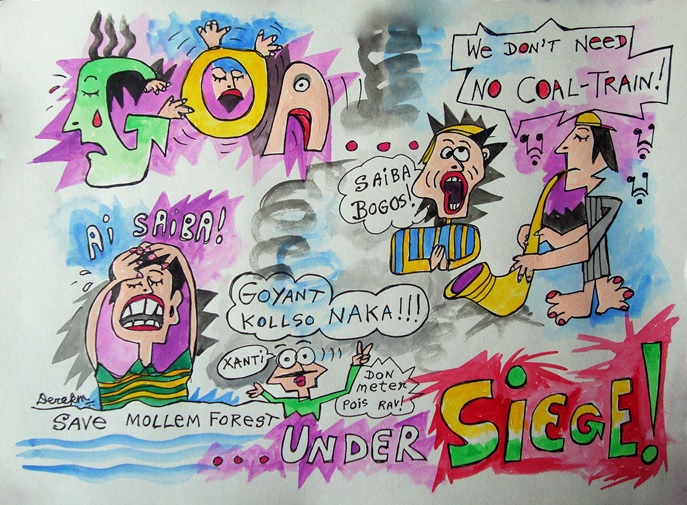
  • Goa’s People say NO to Coal

    Goa’s People say NO to Coal

    [vc_row][vc_column][vc_column_text]

    Illustration by Derek Monteiro. This article has been republished from Sabrang.

    [/vc_column_text][/vc_column][/vc_row][vc_row][vc_column][vc_column_text]As this is being written, the Supreme Leader has inaugurated a zoo in Gujarat. The Minister of Environment, Forests and Climate Change promptly tweeted that this will make people feel as if they are in a jungle. Ironically, the same minister has hastened the destruction of real, vibrant, bio-diverse jungles in the Western Ghats and in the Eastern Himalayas, in the name of development. Right in the middle of a pandemic, that is screaming out loud to anyone who cares to listen “Don’t mess with Nature”. This has certainly fallen on deaf ears in the state government of Goa.[/vc_column_text][/vc_column][/vc_row][vc_row][vc_column][vc_column_text]The people of Goa are battling three linear intrusion projects in Ecologically Sensitive Areas and Protected Areas. These projects – doubling of a railway track, 4 laning of a major highway and installation of a 400 kV transmission line – will hack away 170 hectares of protected forest cover and 240 square kilometers of the Western Ghats, acknowledged as a global biodiversity hotspot. The Environment Impact Assessment (EIA) reports of these three projects have raised several questions by scientists and concerned citizens:

    1. Why are there three mega projects in protected areas? When did these areas lose their protection? How were those decisions taken? What was the involvement of the affected citizens of the state?
    2. Why were Cumulative Impact Studies not conducted to assess impact on both the wildlife in the Mollem area as well as the human habitat around it?
    3. Why were wildlife clearances for two of the projects provided during the pandemic through means that clearly subverted a robust audit and scrutiny?
    4. Why is there an inadequate detail on environment costs and mitigation as also on compensation, penalty and compliance?
    5. The scientific assessment also leaves a lot to be desired – why are several issues like methodology of baseline surveys, afforestation and protection methods, soil erosion and its impact, water and air assessment methods, assessment of insect and fish diversity, snowballing impact of change in microclimates, to name a few, given scant or no review?

    [/vc_column_text][/vc_column][/vc_row][vc_row][vc_column][vc_column_text]The proposed draft EIA 2020 notification had already raised a hue and cry earlier this year. It proposed, among several controversial changes, plans to set aside public consultation and introduce ex-post facto clearances for many projects. If such an EIA process is finally approved, one can reasonably assume safe passage of the three Goa projects, despite a flawed and inadequate EIA around them.[/vc_column_text][/vc_column][/vc_row][vc_row][vc_column][vc_column_text]The ruling party’s own MLA, Alina Saldanha, has been vocal about the havoc these projects will cause to the people of the state. Alleging coal transportation as a key reason, she has expressed concern around the “destruction of the environment, coal dust pollution that will further lead to pulmonary disorders, destruction of people’s houses and Goa’s heritage”.[/vc_column_text][/vc_column][/vc_row][vc_row][vc_column][vc_column_text]Has the country forgotten its obligations to the Climate Change goals as part of the Paris treaty? A quick reminder:

    1. Reduce emissions by a third by 2030, from 2005 baseline
    2. Increase share of the power generated by non-fossil fuels to 40 percent by 2030
    3. Create an additional carbon sink of 2.5-3 Gigatons of CO2e (carbon dioxide equivalent) by 2030 – from enhanced tree and forest cover (this would need 25 million acres of new forests with five billion native trees – a 15 percent increase – roughly the size of 30 Goas in new forest cover)

    [/vc_column_text][/vc_column][/vc_row][vc_row][vc_column][vc_column_text]Any reasonable citizen would question the need to destroy forest land when one must enhance forest and tree cover. One would also question the need for investing in infrastructure to support coal and fossil fuels when the focus must be shifted to renewables. Why do so anyway in a power surplus state? Given the nature of Goa’s landscape, abundant sunshine and its typical Mangalore tile roof-based housing, every house in Goa could be generating its own solar energy and even offering the surplus to the grid, resulting in many micro industries around the same. Goa’s coast-based tourism is already saturated. Keeping its lush hinterland pristine and unspoilt would be the way to develop a premium nature-based tourism and revive the sector. More reason, why these projects will hinder Goa’s future.[/vc_column_text][vc_column_text]

    Any reasonable citizen would question the need to destroy forest land when one must enhance forest and tree cover.

    [/vc_column_text][/vc_column][/vc_row][vc_row][vc_column][vc_column_text]The State’s lack of transparency around the motivation of these projects, its relations, if any, with the project beneficiaries, the inadequate and hurried process surrounding the various environmental approvals and the lack of consultation with citizen groups has led to a public outpouring of peaceful, nonviolent protest uniting various cross-sections of society. Leading the struggle are citizen-led groups such as Goyant Kollso Naka, whose vigilant participation has exposed the facts around power usage in Goa. The name, meaning “Goa Does Not Want Coal” has now become a rallying cry across Goa uniting even the opposition parties such as the Congress, AAP and Goa Forward on standing in solidarity with the citizens. A documentary, The Art of Destructionbrought together some of Goa’s prominent ecologists, environmentalists, architects, activists, artists and government representatives and explored the dilemmas faced in conservation and development and what strikes the right balance.[/vc_column_text][/vc_column][/vc_row][vc_row][vc_column][vc_column_text]Despite these protests, the railway double-tracking project has already begun. Working clandestinely at night amidst heavy security cover, the state has chosen to cock a snook at its people. The same rhetoric that has played elsewhere is playing out in Goa – confuse the people with half-truths & untruths, run roughshod over established norms and processes, decimate the autonomy of institutions, brand the dissenters as anti-state, anti-development and help a few crony companies profit at the expense of the people. The midnight protest on November 1 until 5 AM the following day in Chandor, Goa – the seat of the double-tracking rail project – may well be a turning point. This brought together several thousands of ordinary citizens in an all-night vigil on the railway track that ferries coal through the state. The message was clear – Goa’s people WILL NOT allow Goa to become a Coal Hub. Are the state ministers listening? Is the centre listening?[/vc_column_text][/vc_column][/vc_row][vc_row][vc_column][vc_column_text]Peaceful dissent cannot be de-legitimised. Nor can it be overlooked. An injustice anywhere is an injustice everywhere. What is happening in a corner of Goa may eventually engulf all of Goa. Indeed, the whole country is seeing a cruel, capricious, anti-people decision making in every aspect of governance – an unprincipled demonetisation, a poorly implemented GST, the incarceration of an entire state and its people, a hurried, unplanned lockdown, an uncoordinated pandemic response, arrogant handling of the migrant labour crisis, an insufficient economic revival package – undermining all the socio-economic gains of the previous decade and possibly slipping tens of millions back into poverty.[/vc_column_text][/vc_column][/vc_row][vc_row][vc_column][vc_column_text]Goa has a vibrant culture, natural heritage and a viable economy. Its ecology is its unique selling proposition. Attacking it relentlessly and ruthlessly with illogical projects that reflect 19th-century thinking, could endanger its very existence. The whole country must come together and stand with the people of Goa. In solidarity.[/vc_column_text][/vc_column][/vc_row]

  • Change Must Begin at the Top

    Change Must Begin at the Top

    [vc_row][vc_column][vc_column_text]

    Illustration by Derek Monteiro

    The present IIT Council has one chairperson and 46 members. Only seven of these are women. No woman has ever helmed any IIT thus far. This is after nearly 70 years since the first IIT was established. The number of women who have won the IITB Distinguished Alumni award is even more dismal. The track record of countries, whose COVID-19 response was led by women, is impressive and eons ahead of those that are run by men. This may not be a coincidence. Is it time for a premier IIT to be run by a competent woman? (more…)