Blog

  • From the Beehive

    From the Beehive

    September – October, 2017

    The road of life is full of important choices which lead you to where you are right now. All of us, over the course of our lives, will feel the call to deviate from the more common path. Something inside of us will be called upon to go left, when it seems that everyone else is going right. The pressure to conform, to behave and do as others do can be an overwhelming force indeed. But, this issue is about people from our own campus community who showed courage to deviate from the common path. Without their willingness to explore the road “less traveled by”, our lives may not have been quite so rich at all.


    (more…)

  • Teaching to Play

    Teaching to Play

    Our vision is to get children to play! As simple as that. But it took us 14 years and multiple business models to finally develop an idea that worked. The journey has not been easy. And it started in 2003. We were evaluating many start-up ideas. Nothing clicked. Until a friend shared the story of his son not playing enough and wished that there were more playgrounds. This thought sparked an idea; a business was conceived and a company named SportzVillage was formed in August 2003. (more…)

  • The Future is Here: Connect The Dots To See It

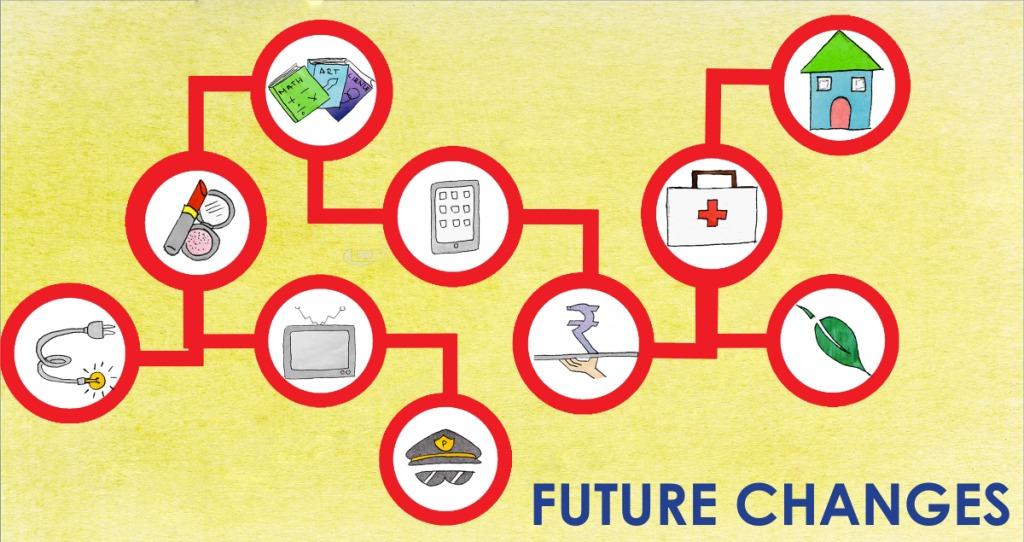
    The Future is Here: Connect The Dots To See It

    Photograph by Alex Wong

    [The article below was originally an Institute lecture given by the author on August 3, 2017. Here’s the link to the video recording.]

    Thank you for giving me the opportunity to deliver this prestigious Institute Lecture. I will not indulge in speculative technology forecasting but all the same, transport you into the future, because the kind of research projects or non-academic careers that you could choose may change if you knew some aspects of the future with a degree of certainty. I will demonstrate that you can even today see many of the things that will, probably, happen in a few years. You just need to identify important technological developments that have already happened and then study their impact, when adopted in specific fields, and then, study the impact of those things on things that lie further downstream. My interest in these things started one summer night in Aberdeen in 2007 when I heard on TV that a British Bank, Northern Rock had collapsed suddenly due to investments in CDS (Collateral Default Swaps), an instrument that most people had not heard of till then. I wondered how things could have been different for hapless investors, if this collapse could have been anticipated. Research led me to understand that Banks were speculating in that instrument and that it was being used by Bankers in the US to create multiple layers of pseudo assets built on poor quality loans given to people with doubtful credit history. After understanding the chain of events backwards from Northern Rock’s collapse to the root cause, I found that if one had worked forward from when reckless trading in naked CDSs had started, it would have been possible to predict the Northern Rock collapse. This thought enthused me to use the same process in the forward direction starting with the then situation, and that led me to believe that the entire global economy will collapse in the next year. I gave talks on this at various public forums from November 2007 until March 2008 by which time the fault-lines became self-evident and the collapse happened in July 2008. Then onwards, for the past decade, I have been using this very simple process of deductive logic for predicting the future after identifying things that can trigger change- social trends, politics and technology amongst many others. That is the secret behind predicting that oil price would collapse in 2008 whilst the general opinion, including that of Goldman Sachs, was that it would rise from $140 per barrel to $180. (more…)

  • You Think You Know Them, But You Don’t – Part II

    You Think You Know Them, But You Don’t – Part II

    Photograph by João Silas

    Last month I offered an illustration of how travel rejuvenates a person, often helping one rediscover a friend’s best qualities. This month’s piece is about travelling with strangers and getting to know them better. (more…)

  • From the Beehive

    From the Beehive

    August – September, 2017

    Our last issue helped you escape to distant lands visited by our writers, this one brings you back to reality with an exploration of current economic and sectoral trends. This month we give you plenty of food for thought on topics such as employment, energy, infrastructure, technology etc. With various experts writing about their domain, you can look forward to understanding the background to some current trends as well as being exposed to a few forecasts for the future. So throw away that crystal ball and get started on Fundamatics instead! (more…)

  • Employment and Energy

    Employment and Energy

    Dr. Romesh Wadhwani, founder of Symphony Technology Group and a philanthropist addressed the crowd of around 1000 IIT ians at a Global Business forum in Goa on October 16, 2015.  His keynote, just after audacious growth targets and expectations were set by the senior members of the IIT Bombay team and the Government representatives, was grounded in a very important but neglected parameter in India’s growth story, that is employment! (more…)

  • The Future of Work

    The Future of Work

    As media works overtime to hype the issue of job losses in Indian IT, the reality is that writers of code are threatening their own jobs! Increased automation and use of tools make it easier and less labour intensive to create software. This is mirroring what is happening in a host of industries, whether manufacturing or services.

    Every technology disruption has led to job losses, and destruction of entire industries or professions. But this time around, we appear to be in a veritable technology storm.  Not one, but many (many!) technologies are supplementing and accelerating each other. (Some call it convergence?!)

    Slowing job growth across the world, coupled with very visible job losses in retail, media, banking, manufacturing, and most traditional/mainstream industries has led to pessimism. After all, in future: cars will drive themselves; machines will print products; algorithms will trade shares; bots will service customers; software will conduct interviews; …

    Naturally, people are scared. Wouldn’t you be?

    (more…)

  • Corporate Governance in a Digital World

    Corporate Governance in a Digital World

    Photograph by Olu Eletu

    As the digital revolution transforms every aspect of our lives – from how we create and consume products and services, to how we communicate, entertain, and relate to one another, the implications for chief executives and boards of directors are almost immeasurable. This comes as public trust in “big business,” according to a 2016 Gallup Poll, is ranked near the bottom of all public institutions – well below even the news media, and just edging out Congress!  Given the lack of public trust due to the financial crisis and the way technology is shifting the employment environment, this is not too hard to understand. What is clear, is that corporate governance must evolve to reflect these rapid and profound economic and societal changes that are happening by the moment. (more…)

  • Infrastructure Funding Gap in India: Role of Bond Distribution through Indian Stock Exchanges

    Infrastructure Funding Gap in India: Role of Bond Distribution through Indian Stock Exchanges

    Matthew Henry

    [This article was written on March 15, 2017.]

    Since taking over the reins of the Government, Hon’ble Prime Minister of India Shri Narendra Modi has taken several steps to create ease of doing business and has also ensured that infrastructure creation goes on at a fast pace. Several countries from Japan to UAE to Saudi Arabia have shown keen interest in investments in India, some of which are now going to go on to the implementation stage, like Mumbai Ahmedabad High Speed Bullet Train, Mumbai Nhava-Sheva Sea link and Smart Cities.However, several of the government projects such as Smart Cities are not able to take off due to lack of funding available for them. (more…)